Eyeglasses have come a long way– from a simple tool for seeing clearly to one of the most personal accessories we wear.
Think about your favorite pair of glasses. Maybe they’re classic and understated. Maybe they’re bold and colorful. Maybe they’re oversized, retro, or just a little bit quirky.
Whatever your style, it’s fascinating to think that eyeglasses weren’t always considered a fashion accessory. For much of their history, glasses were simply something you wore because you needed them,
Today, that’s certainly not the case. Eyewear can make a statement about who you are – and the history of glasses is filled with some pretty memorable statements!
Let’s take a trip through the decades and se how eyewear evolved from a medical necessity into a fashion favorite.
The Early Days: Glasses Were About Seeing, Not Style
The earliest forms of eyeglasses appeared in Europe around the late 13th century. These early spectacles were a far cry from the comfortable, lightweight frames we know today. They generally consisted of two lenses held together by a simple frame and balanced on the nose.
There were no adjustable nose pads, spring hinges, or stylish colors. And forget about choosing between dozens of frame shapes!
Eyeglasses have come a long way
For centuries, glasses remained primarily functional. They were often associated with scholarship and age, rather than fashion.
Eventually, improvements in lens-making and frame construction made glasses more practical- and much more comfortable.
But the real eyewear revolution was still to come.
The 1920’s & 1930’s: Glasses Start Getting Personality
By the early 20th century, eyewear was becoming more recognizable as an accessory.
Round frames were especially popular, giving wearers a scholarly, sophisticated appearance. The development of new materials also allowed manufacturers to create more varied shapes and colors.
And then came a material that would completely change eyewear fashion: celluloid and later plastic.
Plastic frames could be made in a huge variety of colors and patterns, opening the door to something new – glasses could actually be fun.
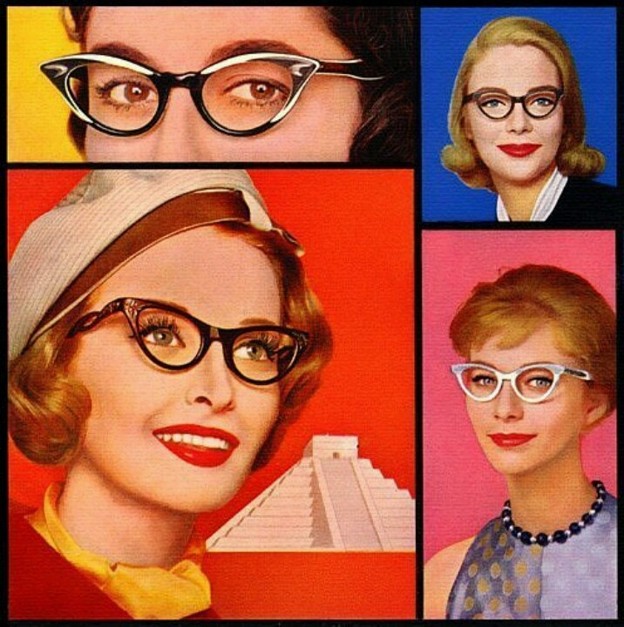
The 1940’s &1950’s: Enter the Cat – Eye
If there’s one eyewear style that immediately transports us back to the 1950s, it’s the cat eye frame.
With their upswept outer corners, cat- eye glasses became closely associated with feminine fashion. They were glamorous, playful, and unmistakably stylish.
This was also the era when eyewear really began to reflect personality. Instead of simply asking, “Which glasses help me see?” people could begin asking, “Which glasses look good on me?”
Sound familiar?
That’s essentially the same question we help our patients answer today.
The 1960’s: Bigger, Bolder, More Experimental
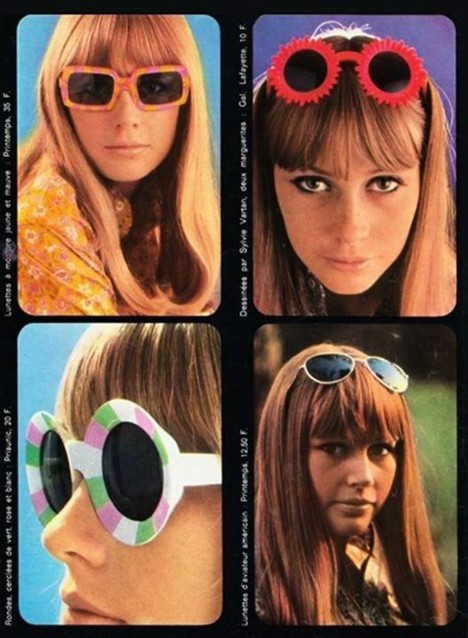
The 1960s brought a spirit of experimentation to fashion – and eyewear was no exception.
Frames became larger and more dramatic.
Geometric shapes appeared, along with bright colors and interesting patterns.
Eyeglasses were no longer something to hide. They were becoming part of the overall look.
And as fashion became more individualistic, eyewear followed right along.
The 1970’s: The Bigger, the Better
If you think today’s oversized frames are big, the 1970’s would like a word. Oversized frames, tinted lenses, aviator-inspired styles, and warm earthy colors dominated the decade.
Brown, amber, gold, and tortoiseshell frames were everywhere.
The 1970s also helped cement the idea that glasses could be a signature accessory. A great pair of frames could become just as recognizable as a favorite handbag or pair of shoes.
The 1980s: Make a Statement
The 1980s took the idea of statement eyewear and turned up the volume.
Frames became larger, more angular, more colorful- and sometimes wonderfully dramatic. Bold geometric shaped and bright plastics were popular and eyewear became an important part of the power – dressing look.
If your glasses made people say, “Wow, those are some glasses!” you were probably doing it right.
The 1990s: Minimalism Takes Over
After the excess of the 1980s, eyewear took a turn toward simplicity.
Small, narrow frames became fashionable, along with minimalist metal styles.
Rimless and semi-rimless designs also gained popularity.
For a while, the goal was almost the opposite of the oversized statement of frame: glasses that were lightweight, subtle, and didn’t attract too much attention.
Of course, fashion has a funny way of coming back around.
The 2000s & 2010s: Everything Comes Back
As we entered the 21st century, eyewear became more diverse than ever.
Retro styles returned. Thick plastic frames became popular again. Wayfarer- inspired shapes, oversized frames, colorful acetates, and vintage inspired designs found new audiences.
And thanks to new advances in lens technology and frame materials, glasses could now be thinner, lighter, more durable, and more comfortable than ever.
Eyewear Today: There Are No Rules
Today, perhaps the biggest eyewear trend is simply choice.
Classic? Absolutely
Colorful? Go for it.
Oversized? Sure.
Minimalist? Of course.
Retro? We have plenty to choose from.
Modern and geometric? You bet.
We have access to an incredible variety of frame shapes, materials, colors, and lens options. And because eyewear has become such a personal part of our appearance, choosing frames is about more than simply finding something that fits.
It’s about finding something that fits you.
So What’s Your Eyewear Era?
One of the most fun things about glasses is that you don’t have to follow the trends.
Maybe you’re a cat-eye person living in a world of minimalist frames. Maybe you love a classic tortoiseshell. Maybe oversized 1970s-inspired frames are completely your thing.
And that’s the beauty of eyewear: there’s a frame for every face, every personality, and every style.
Trends will continue to come and go, but one thing hasn’t changed in hundreds of years- glasses help us see the world more clearly.
Today, they just happen to look a whole lot better while they’re doing it.
Ready for a New Look?
If it’s been a while since you’ve updated your glasses, your next pair might be an opportunity to try something completely different. At Koetting Eye Center, our doctors can make sure your prescription and lenses are right for your vision, while our optical staff can help you find frames that complement your face, lifestyle, and personal style.
After all, your glasses don’t just help you see- they’re one of the first things people see when they look at you.